How Jacketing of Columns Increases Load-Bearing Capacity of Existing Structures
Jacketing of Columns is one of the most effective structural rehabilitation techniques used to strengthen and restore the load-bearing capacity of existing reinforced concrete columns in aging or overloaded structures.
In many old or heavily utilized buildings, columns gradually lose their original strength due to increased service loads, outdated design standards, material deterioration, corrosion of reinforcement steel, and changes in building usage over time. As these factors accumulate, the structural safety of the entire system can become compromised because columns are the primary vertical load-carrying members.
To address this issue without demolishing the structure, jacketing provides a practical and engineered solution. In this method, an additional layer of concrete, steel reinforcement, or composite material is added around the existing column, effectively increasing its cross-sectional area, confinement, and overall structural capacity. This not only improves axial load resistance but also enhances ductility, stiffness, and durability of the member.
Understanding the Structural Role of Column Jacketing
Column jacketing is not merely a repair method; it is a comprehensive structural strengthening strategy designed to enhance the overall performance and capacity of an existing reinforced concrete column. Rather than simply addressing visible damage or deterioration, jacketing improves the structural behavior of the column by increasing its cross-sectional area, providing better confinement to the existing concrete core, and enhancing the reinforcement capacity of the member. As a result, the column becomes capable of carrying higher loads while maintaining improved stability and safety.
When properly designed and executed, jacketing transforms a distressed, deteriorated, or under-capacity column into a stronger composite structural member. The newly added jacket works integrally with the existing column, allowing both the original and added materials to act together under loading conditions. This composite action enables the strengthened column to resist axial loads, bending moments, and shear forces more effectively than the original section alone. By improving the interaction between concrete and reinforcement, column jacketing significantly enhances the structural reliability of the member.
- The increase in load-bearing capacity primarily comes from several key structural improvements.
- The enlarged concrete section provides a greater area to resist compressive stresses, allowing the column to support higher loads.
- Improved confinement of the core concrete enhances its strength and ductility by restricting lateral expansion under compression.
- Additional longitudinal reinforcement contributes to greater axial and flexural capacity, enabling the column to withstand increased structural demands.
- Increased shear resistance helps the column perform better under transverse forces and prevents brittle failure mechanisms.
Furthermore, improved load distribution and ductility allow stresses to be transferred more efficiently throughout the strengthened section, resulting in better overall structural performance and resilience under service and extreme loading conditions.
How Jacketing Increases Load-Carrying Capacity?
The effectiveness of jacketing of columns lies in the fundamental principles of composite action and confinement.
1. Increase in Cross-Sectional Area
By adding new concrete and reinforcement around the existing column, the effective cross-sectional area is increased. Since axial load capacity is directly proportional to concrete area and steel contribution, this leads to a significant improvement in load resistance.
2. Confinement of Core Concrete
One of the most critical benefits is the confinement effect. The new jacket acts as a restraining shell around the original column, preventing lateral expansion of concrete under compression.
This confinement:
- Enhances compressive strength of concrete
- Delays crushing failure
- Improves ductility under seismic loads
3. Additional Longitudinal Reinforcement
Steel reinforcement added in the jacket increases the axial load capacity and improves bending resistance. This is especially important in columns subjected to eccentric loading or seismic forces.
4. Improved Shear Resistance
Existing columns often suffer from inadequate shear capacity, particularly in older structures designed under outdated codes. Jacketing introduces new stirrups and ties, significantly improving shear resistance and preventing brittle failure.
5. Composite Action Between Old and New Materials
Proper bonding ensures that the existing column and the jacketed layer behave as a single structural unit. This composite behavior is essential for effective load transfer and structural stability.
Types of Column Jacketing Methods
Depending on structural requirements and site conditions, different jacketing techniques are used:
1. Reinforced Concrete Jacketing
RCC Column Jacketing the most common method where additional RCC is cast around the existing column along with new reinforcement. It is widely used for heavy load enhancement and seismic strengthening.
2. Steel Jacketing
Steel plates or sections are wrapped around the column and filled with grout or concrete. This method provides high strength with minimal increase in size.
3. Fiber Reinforced Polymer (FRP) Jacketing
FRP wraps are used for confinement and strength improvement without increasing column dimensions significantly. It is suitable for corrosion-prone environments and space-constrained areas.
Step-by-Step Jacketing of Columns Construction Methodology
A successful jacketing of columns process depends heavily on proper execution at the site. The general procedure includes:
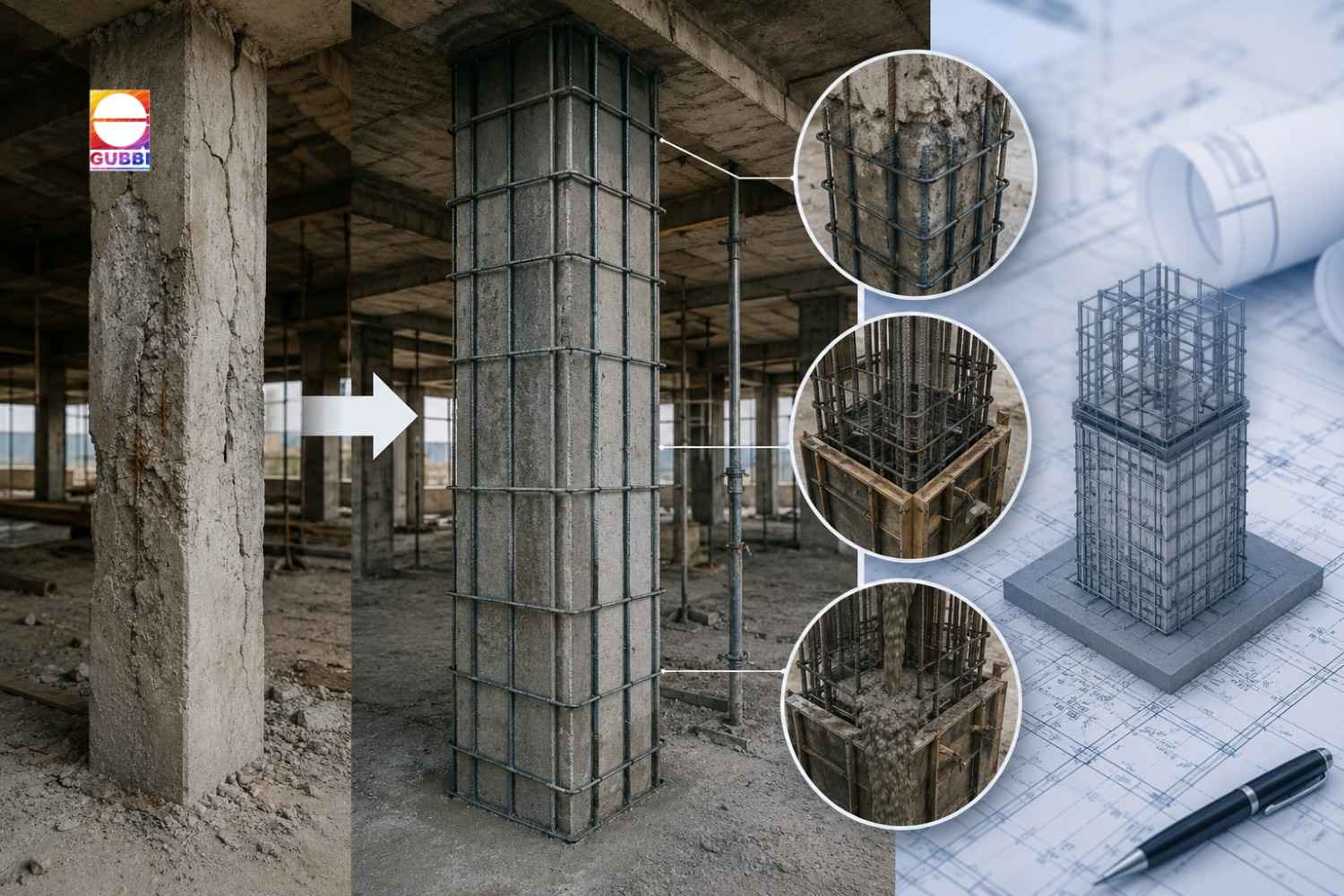
1. Surface Preparation
- Removal of weak or damaged concrete
- Cleaning of reinforcement to remove corrosion
- Roughening of surface to improve bonding
2. Installation of Additional Reinforcement
- Drilling and anchoring dowels into the existing column
- Fixing longitudinal bars and lateral ties
- Ensuring proper alignment and cover
3. Formwork Erection
- Formwork is placed around the column to define jacket thickness
- Proper sealing is ensured to prevent grout leakage
4. Bonding Treatment
- Application of epoxy bonding agents or cementitious slurry
- Ensures effective load transfer between old and new concrete
5. Concrete Placement
- High-quality micro-concrete or shotcrete is used
- Proper compaction is ensured to avoid voids
6. Curing and Finishing
- Adequate curing is critical for strength development
- Formwork is removed after sufficient hardening
Structural Benefits of Jacketing of Columns
When properly designed and executed, jacketing provides multiple engineering advantages:
- Significant Increase in Axial Load Capacity – Increases the column’s ability to safely support higher structural loads and future load demands.
- Improved Seismic Performance and Ductility – Enhances earthquake resistance by improving confinement, flexibility, and energy absorption capacity.
- Enhanced Durability and Extended Service Life – Protects the column from further deterioration and helps extend the lifespan of the structure.
- Restoration of Structural Safety Margins – Recovers lost strength and stability caused by aging, damage, or excessive loading.
- Correction of Design Deficiencies in Older Structures – Addresses inadequate column dimensions and reinforcement found in older construction.
- Better Resistance Against Environmental Deterioration – Improves protection against moisture, corrosion, carbonation, and other environmental factors.
Design Considerations for Effective Jacketing of Columns
Jacketing of columns is not a one-size-fits-all solution. Proper engineering design is essential, considering:
- Existing load conditions and structural demand
- Material properties of old concrete and reinforcement
- Degree of damage or corrosion
- Required increase in load capacity
- Space constraints and architectural limitations
- Seismic zone requirements
Structural analysis is typically performed to ensure that load redistribution after jacketing is safe and effective.
Jacketing of Columns Applications in Real-World Structures
Column jacketing is widely used in:
- Commercial and Industrial buildings undergoing vertical expansion
- Industrial structures with increased machinery loads
- Bridges and flyovers with aging RCC components
- Parking structures exposed to corrosion and heavy loading
- Earthquake-damaged buildings requiring retrofit strengthening
Limitations and Challenges
While highly effective, jacketing must be executed with precision. Common challenges include:
- Ensuring proper bond between old and new concrete
- Space constraints in tightly packed structural grids
- Need for temporary load redistribution during construction
- Skilled workmanship requirement for reinforcement detailing
- Accurate assessment of existing structural condition
Poor execution can lead to composite failure or inadequate strengthening, making technical supervision essential.
Conclusion
Jacketing of columns is a proven and highly effective structural strengthening technique that enhances the load-bearing capacity, stability, and overall performance of existing RCC structures. By increasing the column size, improving confinement, and adding reinforcement, it enables aging or underperforming columns to safely resist higher structural loads while restoring their strength and integrity.
Beyond increasing capacity, jacketing of columns plays a crucial role in extending the service life of structures affected by deterioration, design deficiencies, increased loading requirements, or changing functional demands. The technique improves durability, ductility, and structural reliability, making it a preferred rehabilitation solution for residential, commercial, industrial, and infrastructure projects where demolition is neither practical nor economical.
When supported by proper structural assessment, engineering design, and quality execution, jacketing of columns delivers long-term performance and safety benefits. If your structure exhibits signs of distress or requires additional load-carrying capacity, timely strengthening through professional column jacketing can help prevent further damage, reduce future repair costs, and ensure continued structural stability for years to come.