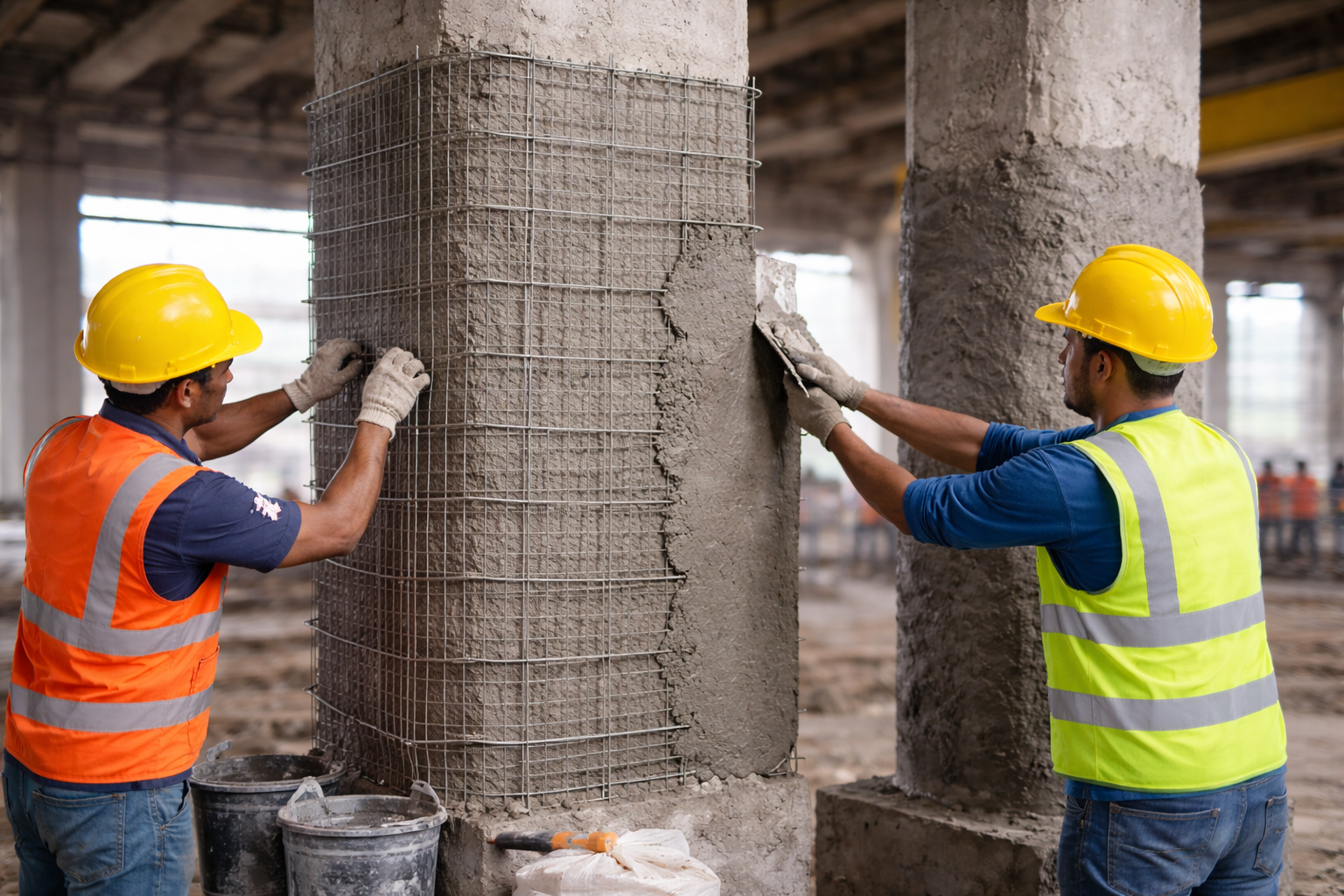
What is Ferrocement Jacketing?
Ferrocement jacketing involves applying a 25-40 mm thick layer of rich cement mortar reinforced with closely spaced wire mesh around existing RCC elements.
The system works through composite action:
- Mesh acts as distributed reinforcement
- Controls crack initiation and propagation
- Mortar ensures strong bonding and stress transfer
- Jacket integrates with the parent concrete member
This results in improved crack resistance and long-term durability.
When Is Ferrocement Jacketing Preferred?
- Moderate strengthening is required
- Surface cracks and minor spalling are present
- Corrosion protection is needed
- Space constraints limit RCC jacketing
- Cost-effective retrofitting is desired
- Work must be executed in occupied buildings
Suitable Structural Elements
Columns – Crack control, surface confinement, corrosion protection
Beams – Reduction in flexural and shear cracks
Slabs – Surface strengthening and improved serviceability
Walls – Enhanced crack resistance and durability
Key Advantages of Ferrocement Jacketing
- Thin and lightweight strengthening system
- Excellent crack resistance
- Cost-effective solution
- Minimal size increase
- Faster execution than RCC jacketing
- Suitable for rehabilitation projects
Limitations
- Limited increase in axial load capacity
- Not suitable for heavily overstressed members
- Requires skilled workmanship and strict quality control
Typical Applications
- Residential and commercial buildings
- Old and distressed RCC structures
- Heritage and low-rise buildings
- Preventive maintenance projects