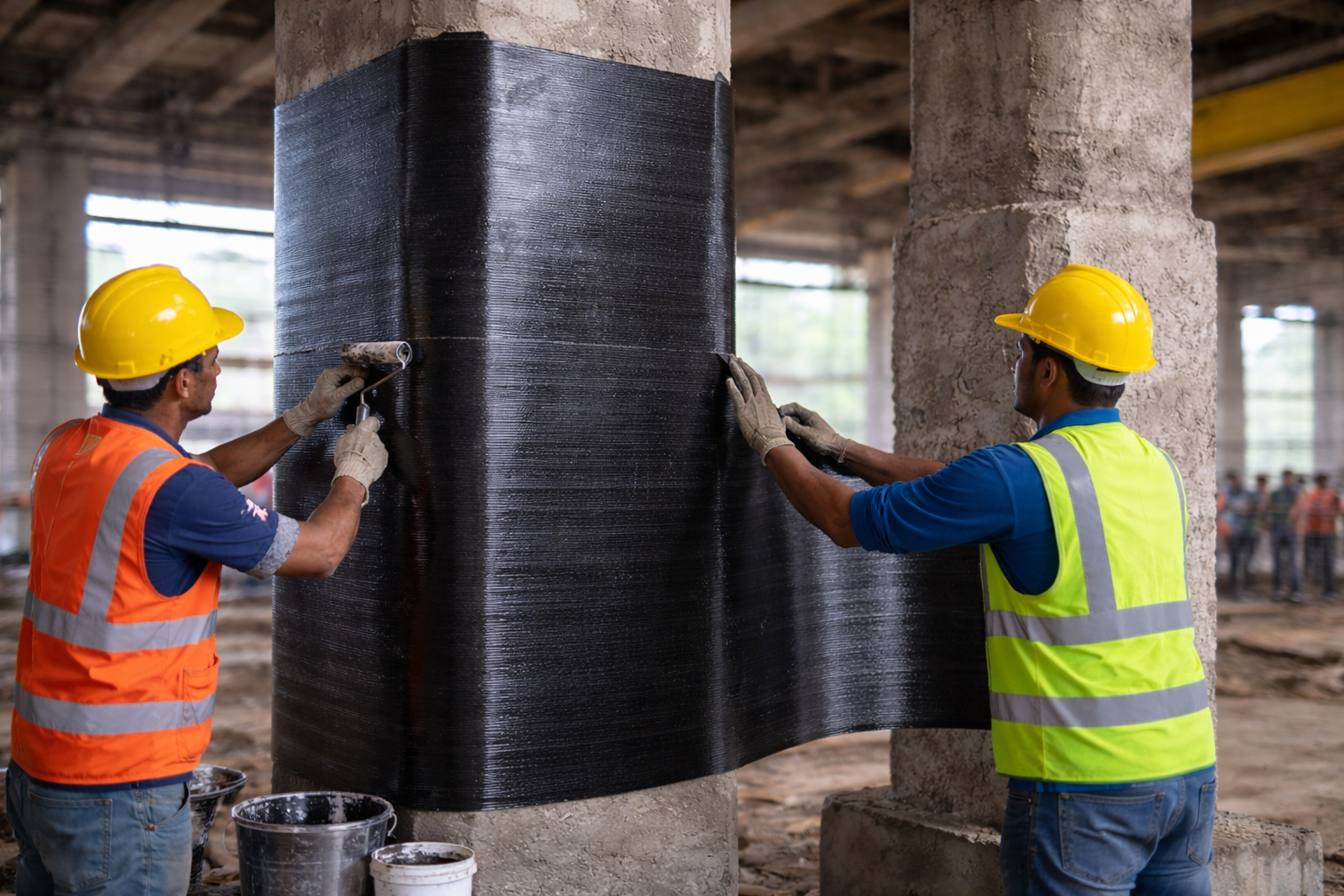
FRP Jacketing of RCC Column Using Carbon Fiber Wrappingg for structural strengthening

FRP Jacketing Services | Advanced Column Retrofitting and Structural Strengthening

FRP (Fiber Reinforced Polymer) jacketing is lightweight, corrosion-resistant, and minimally invasive making it ideal for occupied, space-restricted, and heritage structures. This advanced technique enhances load capacity, ductility, and earthquake resistance without increasing column size or adding significant dead load.

What is FRP Jacketing?

FRP jacketing involves externally bonding high-strength fiber sheets to RCC columns, beams, or slabs using specialized epoxy resins. The fiber wrap acts as a confinement layer, improving:

  • Axial and shear strength
  • Ductility and energy dissipation
  • Crack control and deformation resistance
  • Overall seismic performance

It is widely used in building rehabilitation and infrastructure retrofitting projects.

Why FRP Jacketing Is Preferred?

FRP strengthening is recommended when:

  • Buildings require seismic upgrades
  • Columns show distress or cracking
  • Increased load demands must be met
  • Dead load addition must be minimized
  • Rapid execution with minimal disruption is needed

It strengthens structures without demolition or major civil work.

Types of FRP Used

CFRP (Carbon Fiber Reinforced Polymer)
High tensile strength and stiffness. Best for seismic zones and heavily loaded structures.

GFRP (Glass Fiber Reinforced Polymer)
Cost-effective with good corrosion resistance. Suitable for moderate strengthening.

AFRP (Aramid Fiber Reinforced Polymer)
Used in specialized applications requiring impact resistance.

CFRP vs GFRP: CFRP provides higher strength; GFRP is more economical. Selection depends on structural needs and budget.

Key Advantages of FRP Jacketing

  • No increase in column dimensions
  • Very low additional dead load
  • Fast installation with minimal downtime
  • Excellent corrosion and chemical resistance
  • Clean execution, ideal for operational buildings

Applications of FRP Jacketing

  • Seismic retrofitting of RCC columns and beams
  • Residential and commercial buildings
  • Parking structures and basements
  • Bridges and flyovers
  • Industrial structures in corrosive environments
  • Heritage buildings

Frequently Asked Questions

FRP Jacketing is a structural strengthening technique that uses fiber-reinforced polymer wraps to increase the strength, durability, and load-bearing capacity of RCC columns and beams.

FRP Jacketing offers high strength, lightweight application, corrosion resistance, fast installation, minimal structural disturbance, and improved seismic performance.

FRP Jacketing is used for damaged columns, seismic retrofitting, increasing load capacity, repairing cracks, and strengthening aging RCC structures.

FRP Jacketing is faster, lightweight, and less intrusive, while RCC jacketing provides bulk strength. The best method depends on structural requirements and site conditions.

FRP Jacketing can last 20-30 years or more with proper design, installation, and environmental protection, offering long-term durability and performance.

The cost depends on surface area, damage level, material type (carbon/glass fiber), and site conditions. A structural assessment is required for accurate pricing.

Yes, FRP Jacketing is ideal for retrofitting old and weak structures to restore strength and improve safety without adding significant weight.

The process includes surface preparation, crack repair, application of epoxy resin, wrapping with FRP sheets, and curing to achieve high-strength bonding.

Professional jacketing services ensure proper material selection, correct application, and compliance with engineering standards for safe and effective strengthening.

Strengthen Your Structure with FRP Jacketing Services

Enhance safety, durability, and seismic performance with advanced FRP column retrofitting solutions.